


Edge cloud continuum: just another marketing phrase, or real value for the Industry? In the age of Industry 4.0 and the Industrial Internet of Things (IIoT), manufacturers are drowning in data. Sensors, machines, and enterprise systems generate petabytes of information, yet the real challenge isn't collecting it; it's making sense of it. Data often arrives in disparate formats, with inconsistent semantics, creating a tangled, expensive mess.
Enter a concept that is quickly proving to be the linchpin for seamless digital transformation: the Asset Administration Shell (AAS).
What Exactly is the Asset Administration Shell (AAS)?
Forget complex architectural diagrams for a moment. Think of the AAS as a standardized, structured digital envelope that wraps around a physical or abstract asset. This asset could be anything: a single sensor, a complete machine tool, an entire production line, or even a document-heavy procedure.
The AAS contains all the digital information and functionalities of the asset throughout its entire lifecycle: from design and engineering to operation, maintenance, and eventual recycling. Crucially, this digital envelope is not just a data repository; it's an intelligent interface. It defines:
- What the asset is: Its identification, type, and technical specifications.
- How to interact with it: Its functions, services, and communication protocols (often using technologies like OPC UA or MQTT).
- How to interpret its data: The valid units, ranges, and semantics, ensuring that data from two similar machines, even from different vendors, "feels the same" to a consuming application.
AAS: The Standardized Foundation for Real Digital Twins
 The relationship between the AAS and the digital twin (DT) is often misunderstood. Put simply, the AAS is the standardized implementation of a digital twin for industrial applications within the Industry 4.0 framework.
While a digital twin is the overarching concept of a virtual replica sufficient to meet a set of use cases (e.g., a complex simulation model for aerodynamics), the AAS provides the standardized data model and interoperable interfaces needed to realize a practical, industrial digital twin across different companies and systems.
The AAS functions as the semantic standardization layer of the digital twin. It provides the structured information model that reflects the asset's identity, technical specifications, and operational status. By using universally defined submodels (like IEC 63278, formerly DIN SPEC 91345), the AAS ensures that all partners in the value chain use the exact same "digital language" to describe the asset. This standardization is what transforms a proprietary, isolated digital model into an interoperable digital twin capable of communicating seamlessly in a cross-company industrial ecosystem.
A Digital Bridge for the Industrial Value Chain
The real value of the AAS lies in its ability to enforce data convergence across the entire digital landscape, bridging the chasm between operational technology (OT) and information technology (IT).
From Field Level to Hyperscaler: Achieving Data Convergence
In traditional manufacturing, a sensor on the field level speaks its own proprietary language. Moving that data to the cloud for high-level analytics requires complex, custom-coded translation layers for every single data point.
The AAS eliminates this bottleneck:
- At the edge: The AAS sits directly on or near the asset. It acts as the local translator, structuring the raw, proprietary signals into standardized submodels.
- Across the continuum: Since every AAS uses the same standardized structure, data is inherently consistent and semantically rich. For example, an application running in the hyperscaler (cloud environment) can request the Energy Consumption Submodel from any machine, anywhere, and know exactly how to interpret the data without needing custom integration code.
Creating the Digital Name Plate: Benefits for Component Makers
The AAS is a game-changer for component manufacturers like congatec. By adopting the AAS standard, they can embed a digital name plate (compliant with standards like IEC 61406) directly into their products, such as their Computer-on-Modules (COMs).
The primary advantage is "Plug and Produce" for customers:
Automated system integration: The digital name plate, implemented as an AAS submodel, provides standardized, machine-readable access to static (e.g., serial number, manufacturing date) and dynamic (e.g., current firmware, operating hours) data. Customers of congatec can integrate these modules into their own industrial systems, and the system can automatically identify and configure the COM simply by querying its AAS. This eliminates manual configuration effort, saves days of engineering time, and drastically reduces the risk of human error during system setup and replacement.
Facilitated lifecycle management: By integrating the AAS into their aReady.IOT capabilities, congatec's customers gain immediate, standardized access to crucial operational data. This allows end-users to utilize advanced, high-margin services like automated warranty claims, proactive security vulnerability alerts tied to specific firmware versions, or predictive maintenance warnings for the embedded hardware itself.
Empowering Storage and Cloud Specialists
On the other side of the continuum, specialists in storage and data infrastructure, such as NetApp, also benefit immensely. For them, the AAS solves the problem of data context and governance:
Contextual storage: When industrial data is stored using the AAS structure, it carries its own metadata and context. Instead of just storing a time-series blob labeled "Value 1," the storage system stores a value that is explicitly defined within the AAS, as "Pressure in Bar for Asset XYZ, validated according to Rule ABC." This makes the data immediately valuable for advanced data lakes and analytics.
Data sovereignty and governance: The AAS architecture supports defining data access rights at the asset level. Storage specialists can leverage this structure to ensure that only authorized entities (e.g., a specific maintenance team or a designated cloud service) can access certain submodels, upholding crucial data sovereignty requirements, particularly across international supply chains.
AAS in Action: The Edge-Cloud-Continuum Demonstration
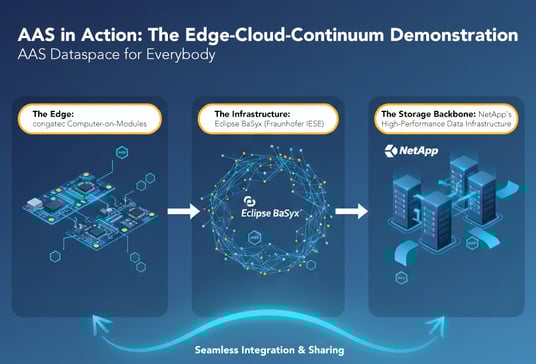 The practical feasibility of the AAS to bridge the OT/IT divide is showcased through joint industry collaborations.
A prominent example is the "AAS Dataspace for Everybody" demonstration, a partnership between NetApp, Fraunhofer IESE in Kaiserslautern, and congatec, often presented at major industrial fairs.
This exhibit demonstrates how:
congatec Computer-on-Modules (representing the edge) generate data, structure it using AAS submodels, and host the digital identity locally.
The open-source middleware Eclipse BaSyx (developed by Fraunhofer IESE) provides the AAS infrastructure that manages the administration shells and links them into a data space.
NetApp's high-performance data infrastructure provides the seamless, secure storage backbone across the Edge-Cloud continuum, making the AAS data instantly available for analytics and sharing in a controlled environment.
This collaboration proves that the seamless integration and sharing of AAS-structured data from embedded components (congatec) to an industrial data space platform (Fraunhofer IESE) and high-performance IT storage (NetApp) is not just a vision, but a fully implemented reality, offering industrial players a first-hand experience of the power of the Edge-Cloud Continuum.
Conclusion: Real Value is Unlocked Interoperability
So, is the "Edge, Cloud, Continuum" a marketing phrase? Perhaps it is, until a standardized technology makes that continuum a reality.
The Asset Administration Shell is that reality check. It provides the essential, missing piece in the puzzle of industrial digitalization: a standardized, self-describing digital identity for every industrial asset.
By providing a common semantic framework, the AAS ensures that data collected at the field level is immediately understandable and usable by sophisticated applications in the cloud, across sites, and throughout the value chain. It’s not about generating more data; it's about making data interoperable, contextualized, and trustworthy. For any company - from chip maker to cloud provider - serious about smart manufacturing, AI adoption, and resilient supply chains, the AAS is the foundation for future industrial competitiveness.
Authors:
Juergen Kreis, Director Business Development Solutions at congatec.
Juergen Hamm, Lead Architect at NetApp. Juergen Hamm is a state-certified technician for automation and manufacturing technology with a degree from the University of Mannheim. He worked for 14 years as a technical consultant at GOPA and Novasoft and now works as Lead Architect Digital Twin Solutions at NetApp Deutschland GmbH, based in Aschheim near Munich.